Loading article
Back to Health Guides
Contraceptive Prescriptions Online: What Telehealth Can and Cannot Do
Pill repeats may be suitable for remote review, but blood pressure, migraine history, clot risk, pregnancy risk, and method choice still matter.
8 min read
·Updated 10 May 2026
·Doctor Reviewed
AHPRA Verified
In this article
- 1Which Methods May Suit Telehealth
- 2First Prescription Versus Repeat Prescription
- 3Combined Hormonal Contraception Needs More Screening
- 4Blood Pressure Matters
- 5Migraine History Is Not A Small Detail
Medical information only. This article is for general information and does not constitute medical advice. Treatment decisions are made by an AHPRA-registered doctor after reviewing your circumstances.
Review
InstantMed Clinical Team
Clinical governance review for guide content
Updated
10 May 2026
General information only, not personal medical advice.
Jump to section
1Which Methods May Suit Telehealth2First Prescription Versus Repeat Prescription3Combined Hormonal Contraception Needs More Screening4Blood Pressure Matters5Migraine History Is Not A Small Detail6Methods That Need In-Person Care7Side Effects That Should Not Be Ignored8Emergency Contraception9Missed Pills And Vomiting10Privacy And Safe Contact11Questions Worth Asking Before You Choose A Method12The Bottom Line13Sources Used In This Guide
Key Information
Contraception prescribing is not just a repeat-script task. The right method depends on health history, pregnancy risk, blood pressure, migraine history, clot risk, medicines, side effects, preferences, and whether the method needs insertion or administration.
Telehealth can be useful for contraception, especially when someone is continuing a stable method and the safety information is up to date. It can also help with counselling, side-effect review, and deciding whether a method still fits.
It is not the right channel for every contraception need. Some methods require a procedure. Some risks need examination, testing, or a more detailed in-person discussion. Some situations are time-sensitive and should go straight to a pharmacy or urgent care.
Which Methods May Suit Telehealth
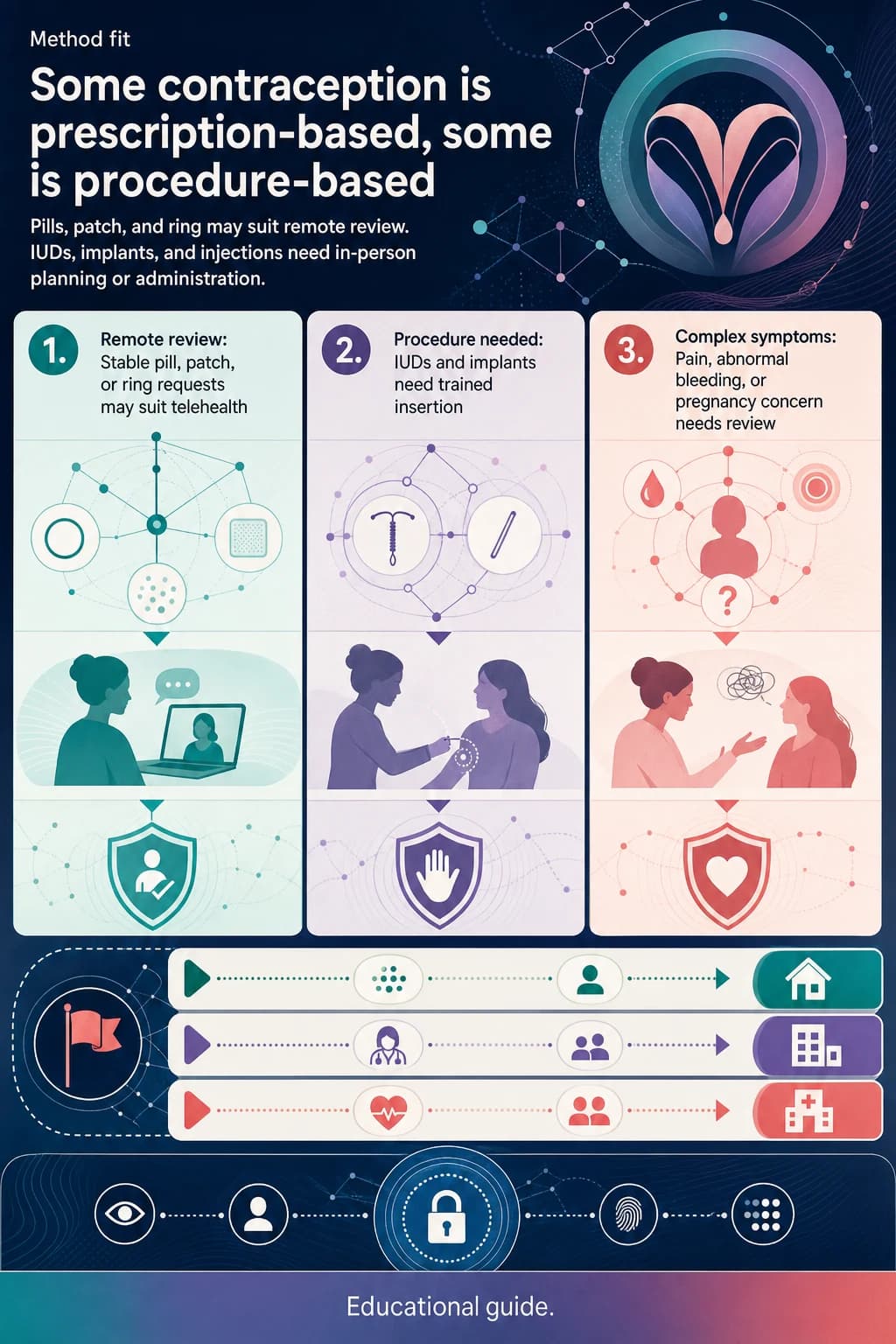
Remote review may be reasonable for:
- Repeat prescriptions for a stable combined oral contraceptive pill
- Repeat prescriptions for a stable progestogen-only pill
- Some requests for the contraceptive patch or vaginal ring
- Side-effect review where symptoms are mild and non-urgent
- Method counselling before arranging in-person insertion
- Planning contraception after stopping another method
Telehealth is less suitable for:
- IUD insertion or removal
- Contraceptive implant insertion or removal
- Injection administration without a safe plan
- New pelvic pain, abnormal bleeding, pregnancy concerns, or possible sexually transmitted infection
- Severe side effects or symptoms suggesting clot, stroke, heart, or liver complications
- Complex medical history where method choice is not straightforward
The distinction is practical. Some contraception is prescription-based. Some is procedure-based. Some is risk-assessment-heavy.
First Prescription Versus Repeat Prescription
A repeat request is usually easier to assess remotely than a first prescription because there is already a known method, a known response, and a history of whether side effects or warning symptoms have occurred. Even then, a repeat is not automatic. The clinician still needs to confirm that the method remains suitable.
A first prescription needs more counselling because the decision includes method fit, correct use, expected bleeding changes, side effects, missed-dose rules, interactions, privacy, and alternatives if the first choice is not suitable.
| Situation | Remote review may be enough when | Stronger in-person care may be needed when |
|---|---|---|
| Stable combined pill repeat | Recent blood pressure is acceptable and no new risk factors have appeared | No blood pressure reading, migraine aura, clot risk, smoking over 35, or concerning symptoms |
| Progestogen-only pill | The person understands strict timing or method-specific instructions | Missed pills, pregnancy concern, complex medicines, or side effects need closer review |
| Patch or ring | History and risks are similar to combined hormonal contraception screening | Skin reactions, clot-risk factors, severe headache, or abnormal bleeding are present |
| IUD or implant planning | The goal is counselling and referral planning | Insertion, removal, pain, pregnancy concern, infection symptoms, or abnormal bleeding need in-person care |
Combined Hormonal Contraception Needs More Screening
Combined hormonal contraception contains oestrogen and a progestogen. This group includes the combined pill, patch, and vaginal ring.
These methods are effective and widely used, but they are not suitable for everyone. The clinician needs to check for risk factors including:
- High blood pressure
- Migraine with aura
- Current or past blood clot
- Strong clotting risk or thrombophilia
- Smoking over age 35
- Some heart or stroke history
- Some liver disease
- Some cancers
- Certain postpartum or breastfeeding situations
- Medicines that interact with hormonal contraception
Healthdirect, RACGP, Family Planning resources, and TGA safety information all highlight blood pressure, migraine, clot risk, age, smoking, and medical history as important parts of combined hormonal contraception safety.
Important Warning
Seek urgent care if you have chest pain, severe shortness of breath, one-sided leg swelling, sudden severe headache, weakness, speech trouble, vision loss, or other stroke-like symptoms while using hormonal contraception.
Blood Pressure Matters
Blood pressure is a key check before starting or continuing combined hormonal contraception. Oestrogen-containing methods can increase blood pressure or clot and cardiovascular risk in some people.
A telehealth clinician may ask for a recent reliable blood pressure reading. This can come from a GP clinic, pharmacy, home monitor, or another valid health setting depending on the circumstances.
If no recent reading is available, the safest next step may be to get blood pressure checked before the prescription decision is made. This is not admin friction. It is part of the risk screen.
Progestogen-only pills do not have the same oestrogen-related clot and blood pressure profile, but they still require clinical screening and correct-use counselling.
Migraine History Is Not A Small Detail
Migraine with aura is a major contraceptive safety detail because combined hormonal contraception can increase stroke risk in this group. Aura can include visual symptoms, tingling, numbness, speech disturbance, or other neurological symptoms before or during migraine.
Do not describe this simply as "headaches" if there are neurological symptoms. The clinician needs the detail.
Risk screen
Blood pressure, migraine with aura, clot history, smoking over 35, and medicines can change suitability.
If combined hormonal contraception is not suitable, other options may still be appropriate, including progestogen-only or non-hormonal methods. That choice should be made with a clinician who understands the risk profile.
Methods That Need In-Person Care
Some contraceptive methods cannot be completed through remote prescribing alone.
| Method | Why telehealth is limited |
|---|---|
| Hormonal IUD | Needs trained insertion, removal, and sometimes examination |
| Copper IUD | Needs trained insertion and assessment of suitability |
| Contraceptive implant | Needs trained insertion and removal |
| Injection | Needs administration plan and suitability review |
| Diaphragm or fitting-dependent methods | May need sizing or hands-on counselling |
Telehealth can still help you understand options and prepare questions. It just cannot replace the procedure.
Side Effects That Should Not Be Ignored
Many contraceptive side effects are mild or settle with time, but some symptoms need prompt assessment. The key is not to dismiss a new symptom simply because contraception is common.
Seek urgent care for chest pain, sudden shortness of breath, coughing blood, one-sided leg swelling, sudden severe headache, weakness, speech trouble, vision loss, fainting, severe abdominal pain, or jaundice. These symptoms are uncommon, but they matter because combined hormonal contraception can be unsuitable for people with clot, stroke, heart, or liver risk.
Less urgent but still important review is needed for persistent mood change, troublesome bleeding, new migraine symptoms, breast symptoms, pelvic pain, pregnancy concern, or side effects that make the method hard to use consistently. The best method is the one that is safe enough and realistic enough for the person using it.
Emergency Contraception
Emergency contraception is time-sensitive. In Australia, emergency contraceptive pills are available from pharmacies without a prescription after pharmacist screening.
If emergency contraception is needed, a pharmacy is usually the fastest pathway. A routine online prescription review may delay care.
After emergency contraception, consider arranging ongoing contraception advice so the next cycle is planned rather than urgent.
Missed Pills And Vomiting
Missed-pill advice depends on:
- Which pill you use
- How many pills were missed
- Where you are in the pack
- Whether sex occurred during the risk window
- Whether vomiting or diarrhoea affected absorption
- Whether interacting medicines were used
Do not rely on generic internet rules if the stakes are high. Check the patient information leaflet for your exact pill, ask a pharmacist, or seek clinical advice. Family Planning resources and pharmacist counselling are often the most practical first stop for time-sensitive missed-pill questions.
Privacy And Safe Contact
Contraception privacy can matter for many reasons: family privacy, partner safety, cultural concerns, workplace privacy, or personal preference.
Before using any service or pharmacy, consider:
Privacy planning
Phone, email, pharmacy pickup, bank statements, and shared accounts can all affect contraception privacy.
- Which phone number and email are safe to use
- Whether someone else can access your messages
- What name appears on bank statements
- Whether pharmacy collection could expose private information
- Whether My Health Record, Medicare, insurance, or shared family accounts are relevant
- Whether you need family violence or reproductive coercion support
A good health service should take privacy seriously, but no service can control every bank, device, family account, or pharmacy context. Plan the safe contact pathway first if privacy creates risk.
Questions Worth Asking Before You Choose A Method
Good contraception counselling should make the trade-offs explicit. Useful questions include:
- Do I want a daily method, a weekly or monthly method, or a long-acting method?
- Do I need bleeding control, contraception only, acne benefit, period suppression, or another goal?
- Do I have migraine aura, high blood pressure, clot history, smoking risk, liver disease, breast cancer history, or interacting medicines?
- Would an unplanned pregnancy create medical, safety, privacy, study, work, or relationship risks?
- Can I take a pill at the same time every day, or would a longer-acting method be more realistic?
- Do I need pharmacy pickup, payment, email, phone, or My Health Record privacy planning?
These questions do not have one universal answer. They make the prescribing conversation safer and more useful than simply asking for "the pill".
The Bottom Line
Online contraception prescribing can be safe and practical for some people, especially for stable repeat pill requests with current safety information.
The best contraception care is not simply the fastest prescription. It is the method that fits your body, preferences, risk factors, and life. Blood pressure, migraine aura, clot history, smoking, postpartum status, medicines, and procedure needs all matter.
Sources Used In This Guide
- Healthdirect Australia: combined oral contraceptive pill and contraception information
- RACGP: oral hormonal contraception in special circumstances
- Therapeutic Goods Administration: combined hormonal contraceptive safety information
- Family Planning Australia and Family Planning Alliance Australia contraception resources
- The Royal Women's Hospital: contraceptive pill information
Frequently Asked Questions
Can I get the contraceptive pill online in Australia?
Sometimes. Remote review may be suitable for some repeat or low-risk pill requests when the clinician has enough history, blood pressure information where relevant, and no safety concerns. First prescriptions or higher-risk situations may need in-person assessment.
Do I need a blood pressure check for the combined pill?
Blood pressure is an important safety check for combined hormonal contraception because oestrogen-containing methods can increase clot and cardiovascular risk in some people. A recent reliable blood pressure reading may be needed before prescribing or continuing the combined pill, patch, or ring.
Can telehealth prescribe an IUD or implant?
Telehealth can provide counselling and planning, but IUDs and contraceptive implants need trained in-person insertion and removal. Injections also need an administration plan and may not be suitable for remote-only care.
What makes the combined pill unsafe for some people?
Risk factors include migraine with aura, current or past blood clots, uncontrolled high blood pressure, some heart or liver conditions, certain cancers, smoking over age 35, and some postpartum or breastfeeding situations. A clinician needs to check these before prescribing.
Is emergency contraception available online?
Emergency contraception is time-sensitive and is available from Australian pharmacies without a prescription after pharmacist screening. If emergency contraception is needed, going directly to a pharmacy is usually faster than waiting for a routine telehealth review.
InstantMed Medical Team
Related Articles

8 min read
Amoxicillin in Australia: Uses, Dosing, and What to Know
Amoxicillin is a penicillin antibiotic used for selected bacterial infections. It does not treat viruses, and the right dose depends on the infection, person, and clinical context.
InstantMed Medical Team

8 min read
When Antibiotics Are Appropriate: Bacterial vs Viral Infections
Antibiotics treat bacterial infections, not viruses. This guide explains when antibiotics may be appropriate, when they are usually avoided, and what responsible use looks like.
InstantMed Medical Team
9 min read
Asthma Management and Telehealth in Australia
Stable, established asthma may suit telehealth medication review, but diagnosis, worsening symptoms, children, and asthma attacks need in-person or emergency care. Learn the safety boundaries.
InstantMed Medical Team